
Leave Your Message
Explore our leading water-cooled UV LED lamps engineered for extreme durability and precise wavelength delivery across label printing and resin curing applications.
Understanding the transition from traditional mercury vapor lamps to high-efficiency solid-state UV LED technology.
The manufacturing sector is undergoing an unprecedented shift toward digital precision and energy conservation. At the heart of this movement is the widespread adoption of UV LED Curing Systems for UV Label Printing, which have also proven highly transformational when configured for 3D Printing and Resin Curing. Traditional medium-pressure mercury arc lamps, which dominated industrial drying lines for decades, are rapidly being phased out. This shift is driven by strict environmental regulations, such as the European Union’s RoHS directive, and a pressing commercial need to reduce operating costs and increase line throughput.
Globally, the market for UV LED curing systems is expanding at a double-digit compound annual growth rate (CAGR). Regulatory bodies worldwide are restricting mercury-containing equipment, directly driving print shops and additive manufacturers to seek solid-state alternatives. Furthermore, corporate sustainability mandates require production managers to lower energy consumption. UV LED systems consume up to 70% less electricity than legacy mercury systems, which require constant high-power operation and extensive cooling infrastructure.
One of the key technical advantages of UV LED curing is thermal management. Mercury lamps emit a broad spectrum of light, including infrared (IR) wavelengths, which generate intense heat. This heat frequently damages thin plastic films, heat-sensitive paper, and delicate polymers used in label printing. UV LED curing systems emit a narrow band of ultraviolet light (typically 365nm, 385nm, 395nm, or 405nm) without producing IR radiation. This "cold curing" capability allows manufacturers to utilize thinner, more cost-effective substrates, expanding their product offerings and reducing raw material costs.
How water-cooled UV LED systems optimize high-speed digital label production and ensure superior ink adhesion.
In modern label printing, digital inkjet and flexographic presses operate at high speeds, often exceeding 150 meters per minute. To maintain print quality and prevent ink bleeding, inks must be cured or "pinned" instantly. High-power, water-cooled UV LED curing systems are uniquely suited to meet these demands.
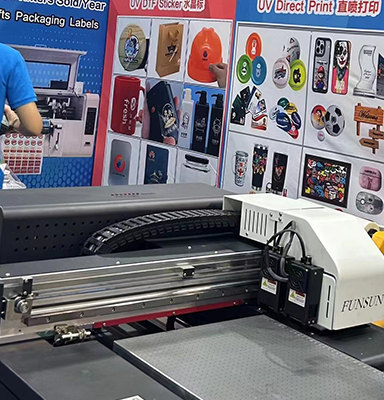
Industrial digital printers utilize high-resolution printheads like the Epson i3200, Ricoh G5/G6, and Toshiba CEN4. These systems require compact, high-output curing lamps that can be mounted directly adjacent to the printhead carriage. Water-cooled UV LED lamps, such as the SU-F802035D, offer the perfect form factor and thermal stability. By circulating water through a closed-loop cooling system, the LED junction temperature remains stable, ensuring consistent UV output (irradiance) even during continuous, multi-shift production runs.
UV-curable inks contain photoinitiators that absorb UV light and trigger cross-linking, turning liquid ink into a solid film in milliseconds. Because UV LED lamps reach full intensity instantly—with no warm-up or cool-down cycles—press operators can start and stop lines without wasting substrate. The high peak irradiance ensures that the UV light penetrates deep into heavily pigmented inks, achieving complete curing and excellent adhesion to challenging non-porous substrates like vinyl, polyester, and metallic foils.
Exploring the intersection of additive manufacturing, photopolymerization, and post-curing processes.
Additive manufacturing processes, including Stereolithography (SLA), Digital Light Processing (DLP), and Liquid Crystal Display (LCD) 3D printing, rely entirely on the precise polymerization of photosensitive liquid resins. The mechanical properties of the finished 3D-printed part depend heavily on the wavelength accuracy and uniformity of the UV light source.
Photopolymer resins are formulated to react to specific UV wavelengths. Most commercial 3D printing resins cure optimally under 385nm or 405nm light, while industrial adhesives and conformal coatings often require 365nm or 395nm. A major benefit of UV LED curing systems is their narrow spectral output (typically +/- 5nm), which matches the absorption spectrum of the resin's photoinitiators. This results in faster layer-by-layer cure times, sharper feature resolution, and minimizes the risk of over-curing or under-curing, which can lead to warping or structural failure.
When a part is first printed, it is in a "green" state, meaning it has not yet achieved its maximum cross-linking density. Post-curing using high-intensity UV LED lamps is a necessary step to achieve the desired tensile strength, hardness, and thermal resistance. This is particularly crucial in dental, medical, and aerospace applications, where parts must meet strict mechanical tolerances. Uniform irradiance across the entire surface area of the post-curing chamber prevents uneven shrinkage and ensures structural integrity.
Sulodak (Shenzhen) Technology Co., Ltd. is located in the high-tech manufacturing hub of Shenzhen, Guangdong, China. Established in 2020, our team brings together more than 10 years of combined experience in developing state-of-the-art UV LED curing systems. We are dedicated to delivering innovative, energy-efficient, and highly customized UV curing solutions that empower our clients to increase productivity, lower operational costs, and reduce their environmental footprint.
With strict adherence to international quality standards, all Sulodak products have successfully passed CE and RoHS certifications, ensuring compliance with global environmental and safety directives. Our ultimate goal remains unchanged: to become our customer's first choice forever.
View More About Us
Sulodak's UV LED curing solutions are deployed worldwide across a diverse range of demanding industrial applications.


As a leading provider of UV LED curing solutions, we offer unparalleled engineering expertise, customization capabilities, and global support.

With 10+ years of expertise in UV LED curing engineering, we design and manufacture bespoke arrays tailored to your specific mechanical and optical requirements.

We offer specialized curing systems that optimize productivity, lower energy consumption, simplify workflows, and maximize profitability for your factory.

Our service begins with initial consultation and extends through the lifecycle of your system, providing installation guidance, training, and maintenance.

Sulodak has established a mature distribution and marketing network spanning more than 80 countries, delivering reliable local support and quick response times.
Every UV LED curing module undergoes a rigorous, multi-stage assembly and quality control process to guarantee long-term reliability.
We collaborate with leading companies worldwide to develop and deliver cutting-edge UV LED curing solutions.


All Sulodak products meet strict international safety and environmental standards, ensuring reliable performance in global markets.


Exploring the future of smart UV curing, multi-wavelength integration, and advanced thermal design.
As industrial automation advances, the requirements placed on curing systems are growing more sophisticated. The industry is moving beyond simple on/off control toward smart, integrated networks that communicate directly with printing and production software.
Modern UV LED curing systems are equipped with embedded sensors that monitor diode temperature, current, and optical output in real-time. This telemetry data allows production managers to perform predictive maintenance, identifying potential issues before they cause line downtime. For example, a sudden rise in temperature can signal a restriction in the water-cooling system, prompting maintenance before the LEDs degrade.
To cure composite materials or thick coatings, single-wavelength curing is sometimes insufficient. Surface curing is best achieved using shorter wavelengths (e.g., 365nm), which cure the outer layer rapidly to prevent oxygen inhibition. Deep-layer curing, however, requires longer wavelengths (e.g., 395nm or 405nm) that can penetrate further into the material. Hybrid UV LED arrays combine multiple diode types on a single board, allowing manufacturers to achieve complete polymerization from the surface to the substrate in a single pass.
As environmental regulations tighten globally, the formulations of inks, varnishes, and resins are evolving. Chemical companies are developing new photopolymers that are optimized specifically for UV LED wavelengths. This co-development of chemistry and hardware ensures that UV LED curing systems will continue to deliver superior mechanical properties, faster processing speeds, and lower energy footprints, solidifying their position as the dominant curing technology of the future.
Browse our complete catalog of industrial UV LED curing lamps, featuring water-cooled systems optimized for label printing, screen printing, and resin curing.


